
Scottish American War Memorial
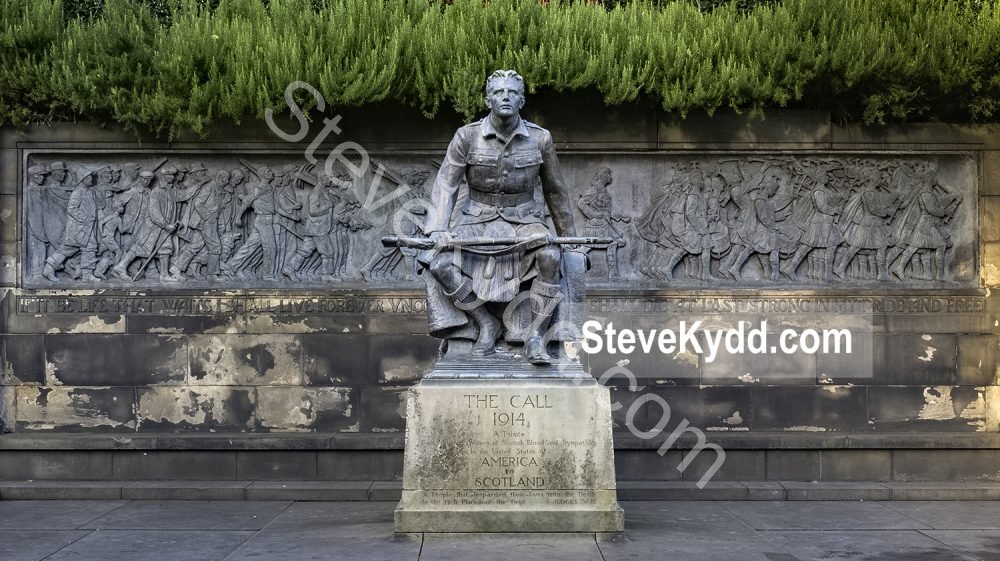
Standing beneath Edinburgh Castle in West Princes Street Gardens, the Scottish American Memorial, better known as The Call 1914, commemorates Scots who served and died during the First World War. It is also an enduring symbol of the historic ties between Scotland and the United States.
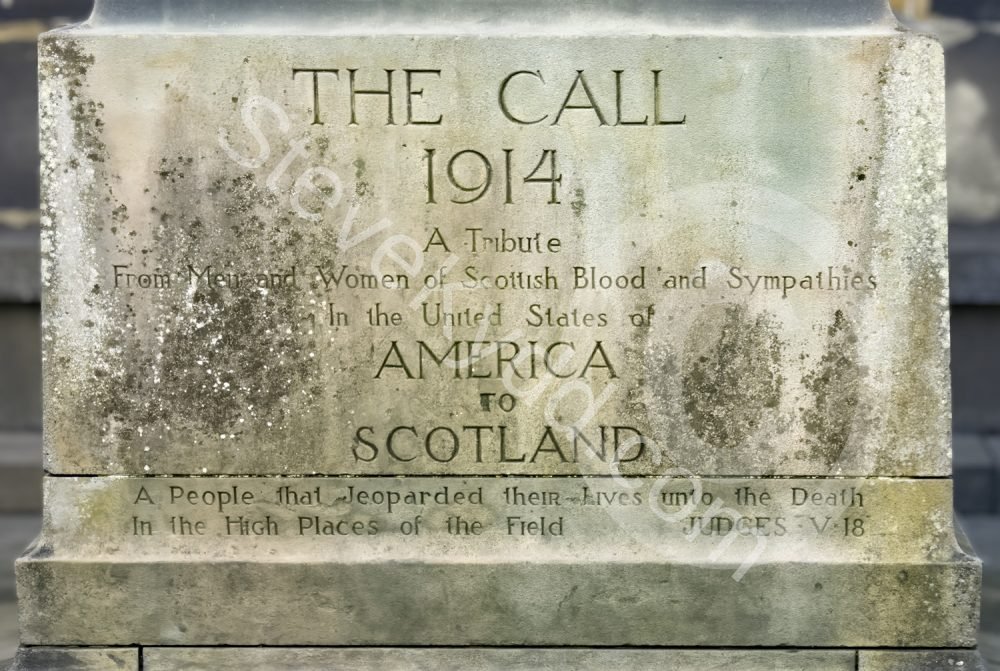
People of Scottish descent in the United States largely funded the memorial, rather than the British government or the City of Edinburgh. In 1923, a committee in America began raising money from those described at the time as people of “Scots blood and sympathy.” They aimed to create a permanent memorial in Scotland to honour the sacrifice of Scottish service members during the Great War.
The Call – 1914

The most striking element is the solitary bronze figure of a Scottish infantryman in Highland dress. Sitting with his rifle beside him, the soldier looks across Princes Street Gardens towards Edinburgh Castle.
The figure is deliberately restrained. Rather than depicting the excitement of battle or military triumph, sculptor Robert Tait McKenzie created a thoughtful, almost sombre soldier. The result is a memorial concerned as much with duty, sacrifice and remembrance as with military service.
Behind him stretches an impressive bronze bas-relief. It gives the memorial its wider narrative.
The figures in the relief represent Scottish civilians from different walks of life responding to the outbreak of war in 1914. Men leave their peacetime occupations and gradually become soldiers, ordinary Scots answering “The Call.”
The contrast between the soldier and the procession behind him, civilians transformed by war, is particularly effective.
Scottish American Memorial by Robert Tait McKenzie
The memorial was the work of Robert Tait McKenzie (1867–1938), a Canadian-born sculptor, physician and physical educator of Scottish ancestry.
He was Professor and Director of Physical Education at the University of Pennsylvania, and his knowledge of anatomy gave his sculpted human figures a convincing physical presence.
Work on The Call took around four years.
The Roman Bronze Works in New York, one of America’s most important bronze foundries, cast the bronze statue and bas-relief before transporting them across the Atlantic to Edinburgh.

An Edinburgh Setting
The distinguished Scottish architect Reginald Fairlie (1883–1952) designed the architectural setting.
Fairlie chose Craigleith sandstone, a material closely linked to Edinburgh’s architecture. By doing so, he made the American-funded and American-cast memorial feel like a natural part of the city.
Its location was equally significant.
Placed in Princes Street Gardens, beneath the great rock of Edinburgh Castle, the memorial occupies one of the city’s most dramatic settings. The kilted soldier appears to look towards the Castle, a military stronghold for centuries and later home to the Scottish National Memorial, which opened the same year.

Close-up of soldier on the Scottish American Memorial
The Words of E. Alan Mackintosh
At the foot of the relief are words by another Scottish soldier whose life was cut short by the war:
“If it be life that waits, I shall live forever unconquered; if death, I shall die at last strong in my pride and free.”
They come from “A Creed”, written in 1916 by the Scottish poet and soldier Ewart Alan Mackintosh.
Mackintosh served with the 5th Battalion, Seaforth Highlanders, part of the 51st (Highland) Division, and was awarded the Military Cross for bravery. He died in the Battle of Cambrai on 21 November 1917 at just 24 years old.
His words add poignancy to the memorial. They were not written decades later as a retrospective interpretation of the war, but by a young officer who knew that he might not survive it.
Unveiled in 1927
The completed memorial was unveiled on 7 September 1927 by Alanson B. Houghton, the United States Ambassador to Britain.
Houghton was also presented with the Freedom of the City of Edinburgh, underlining the importance attached to the occasion and to the relationship between Scotland and the United States.
The ceremony took place less than a decade after the end of the First World War, when memories of the conflict and of those who had failed to return were still very immediate.
Scotland and America
What makes The Call unusual among Edinburgh’s many monuments is the story behind its creation.
It commemorates Scottish sacrifice, but it was conceived and financed across the Atlantic. Descendants of Scots who had emigrated to America created a memorial in the country their families had come from.
People can interpret it in two ways: as a First World War memorial and as a Scottish-American monument.
For generations, Scots had emigrated to the United States while retaining a strong attachment to their ancestral country. Scottish societies, Burns clubs, St Andrew’s societies and other organisations helped maintain those connections. The fundraising for The Call was another expression of that relationship.
The monument effectively links three groups: the Scots who fought in the First World War, the Scots who had emigrated overseas, and their descendants who continued to identify with Scotland.
Almost a century after its unveiling, the Scottish American War Memorial remains one of the most powerful monuments in Princes Street Gardens. Thousands of people pass it every day, yet its location beneath the Castle may overshadow the remarkable international story behind it.
A Scottish soldier, sculpted by a Scottish-Canadian artist, cast in Brooklyn, paid for by Scottish-Americans and installed in the heart of Edinburgh: The Call is as much a monument to Scotland’s connections with the wider world as it is a memorial to the generation lost in the First World War.
Click on any image to license via ALAMY
Search
