

Coastal Command Scottish Memorial, North Berwick, East Lothian, UK.
Coastal Command in Scotland: Guarding Britain’s Northern Seas
When the Second World War began in 1939, Britain’s survival depended not only on armies and fighter aircraft, but on control of the seas. Every day merchant ships crossed the Atlantic carrying food, fuel, weapons and troops. German U-boats, surface raiders and long-range aircraft threatened these lifelines, making the surrounding waters among the most dangerous battlefields of the war.
Few parts of Britain were more important to this struggle than Scotland.
With thousands of miles of coastline, access to the Atlantic, the North Sea and the Norwegian Sea, and a network of strategically placed airfields, Scotland became one of the principal bases of RAF Coastal Command. From here, crews flew long, lonely patrols in every kind of weather, searching for enemy submarines, escorting convoys, rescuing survivors and protecting Britain’s maritime lifeline.
Today their contribution is remembered by memorials across Scotland, including the impressive Coastal Command Memorial at North Berwick, which overlooks the very waters once patrolled by these courageous airmen.
What Was RAF Coastal Command?
RAF Coastal Command was established in 1936, initially tasked with protecting Britain’s coastlines and carrying out maritime reconnaissance. During the Second World War its responsibilities expanded enormously.
Its aircraft were used to:
- Hunt German U-boats.
- Escort Atlantic convoys.
- Patrol Britain’s coast.
- Locate enemy surface ships.
- Lay naval mines.
- Attack enemy shipping.
- Rescue downed aircrew and sailors.
- Gather vital intelligence over occupied Europe.
Unlike Fighter Command or Bomber Command, Coastal Command rarely attracted newspaper headlines. Yet many historians now regard its work during the Battle of the Atlantic as one of the decisive factors in Britain’s eventual victory.
Prime Minister Winston Churchill famously remarked that the Battle of the Atlantic was the only battle that truly frightened him throughout the war.
Scotland’s Strategic Importance
Scotland’s geography made it indispensable.
Aircraft operating from Scottish bases could reach far into the North Atlantic, cover convoy routes around northern Britain, and patrol the sea lanes leading towards Iceland, Norway and the Arctic.
The country’s rugged coastline also offered numerous sheltered harbours and naval anchorages, allowing close cooperation between the Royal Air Force and the Royal Navy.
As the war progressed, Scottish airfields became increasingly busy with aircraft departing before dawn and often returning many hours later after exhausting patrols over cold, hostile seas.
Scottish Coastal Command Airfields
Many Scottish airfields became household names within Coastal Command.
RAF Leuchars (Fife)
Perhaps Scotland’s best-known Coastal Command station, RAF Leuchars became home to long-range maritime reconnaissance aircraft including the famous Avro Shackleton after the war.
During WWII it flew anti-submarine patrols over the North Sea and protected the vital eastern approaches to Britain.
RAF Wick
Far to the north, Wick’s location made it ideal for operations towards Norway and the Norwegian Sea. Aircraft based here regularly searched for German naval activity and escorted Arctic convoys.
RAF Tiree
The remote Hebridean island of Tiree became one of Britain’s most important Atlantic patrol bases. From here, long-range aircraft could cover huge stretches of ocean that had previously been beyond Allied reach.
RAF Benbecula
Operating in difficult weather conditions almost year-round, Benbecula helped patrol the western approaches and provided another vital stepping stone into the Atlantic.
RAF Castle Archdale and Northern Bases
Although located in Northern Ireland, these worked closely with Scottish stations as part of the wider Atlantic patrol network, sharing responsibility for protecting convoys crossing the ocean.
Many other Scottish airfields—including Dallachy (Spey Bay), East Fortune, Sumburgh, Milltown, Stornoway, Montrose, and Oban—also played important supporting roles during the conflict.
The Aircraft
Coastal Command flew an extraordinary variety of aircraft throughout the war.
Among the best known were:
- Short Sunderland flying boats
- Consolidated Catalina flying boats
- Lockheed Hudson
- Vickers Wellington
- Bristol Beaufighter
- De Havilland Mosquito
- Avro Anson
Later in the war, the arrival of the American-built Consolidated Liberator transformed anti-submarine warfare by giving Coastal Command the long-range capability needed to close the notorious “Mid-Atlantic Gap” where convoys had previously sailed beyond air cover.
Fighting the U-boats
German submarines posed Britain’s greatest maritime threat.
Convoys carrying food and fuel became prime targets for packs of U-boats operating across the Atlantic.
Coastal Command aircraft constantly searched enormous areas of ocean, sometimes flying patrols lasting more than twelve hours. Spotting a submarine often depended on sharp eyesight, experience and no small amount of luck.
Once located, aircraft attacked using depth charges, bombs and later homing torpedoes.
Even when they failed to sink a submarine, merely forcing it to remain submerged slowed its progress and prevented it from attacking convoys.
This relentless pressure gradually shifted the balance of the Battle of the Atlantic in the Allies’ favour.
Long Hours Over Empty Seas
Flying with Coastal Command demanded exceptional endurance.
Unlike fighter pilots engaged in brief aerial combat, Coastal Command crews often spent entire days crossing featureless ocean with little sign of the enemy.
Navigating the vast ocean was a constant challenge, with weather conditions shifting unpredictably and ice quickly building up on aircraft wings.
Mechanical problems could easily prove fatal. If a plane went down in the frigid Atlantic, survival was usually a matter of minutes. Tragically, many crews were lost without a trace.
The Human Cost
Coastal Command suffered some of the highest casualty rates of any RAF command.
More than 10,000 personnel lost their lives during the Second World War.
Many died not in combat but through weather, navigational accidents or ditching in freezing seas far from rescue.
Their sacrifices were largely overshadowed after the war by the better-known stories of Fighter Command during the Battle of Britain and Bomber Command’s strategic offensive.
Only in recent decades has wider public recognition begun to reflect the importance of their contribution.
The Coastal Command Memorial at North Berwick

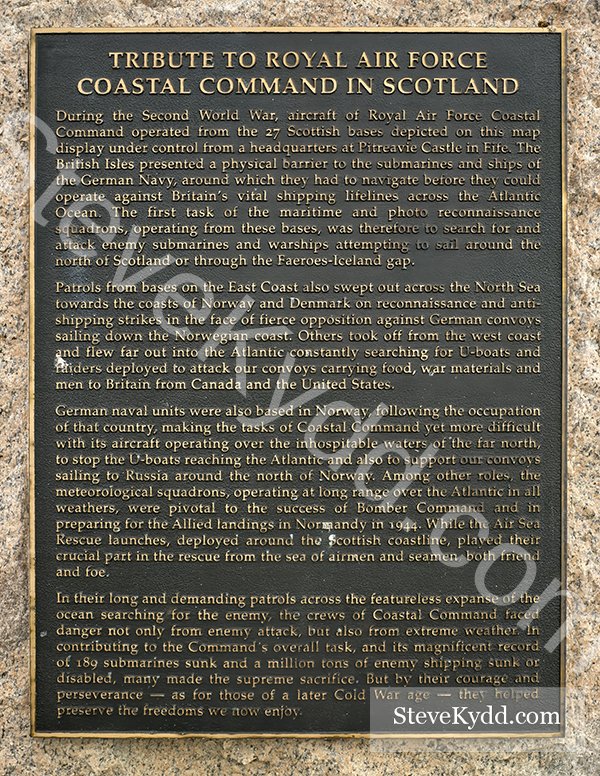
Detail of the Coastal Command Scottish Memorial.
Standing on the East Lothian coastline, the Coastal Command Memorial at North Berwick provides a fitting tribute to those who served.
Looking out across the Firth of Forth and the North Sea, visitors can easily imagine the countless aircraft that once passed overhead on patrol.
The memorial honours the thousands of aircrew who never returned from operations over the sea and recognises the vital role CC played in protecting Britain’s maritime lifelines.
East Lothian’s coastline lay beneath many wartime patrol routes, while nearby airfields and military installations formed part of Scotland’s extensive wartime defensive network.
The memorial reminds us that victory in the Second World War depended on thousands of routine patrols carried out in dangerous conditions by crews who often received little public recognition.
Legacy
RAF Coastal Command helped ensure Britain remained supplied throughout the war.
By reducing the U-boat threat, protecting convoys and supporting Allied naval operations, it played a decisive role in securing eventual victory.
Many former Scottish Coastal Command airfields have returned to civilian use, while others continue military service in different roles. The memorial at North Berwick ensures that the courage and endurance of Coastal Command’s airmen are not forgotten.
Their story is one of perseverance fought over grey seas and grey skies, where patience, professionalism and brave determination helped to end the war.
Further Reading
Search