

Long shadows on the evening paseo in Santo Domingo De La Calzada
For more than a thousand years, Santo Domingo de la Calzada has been one of the most important stopping places on the Camino Francés, the most popular route to Santiago de Compostela. Located in the Rioja region of northern Spain, the town owes its very existence to one man’s determination to make the journey safer for pilgrims.
Today, thousands of walkers pass through its medieval streets every year, pausing to admire its magnificent cathedral, sample Rioja wine and discover one of the Camino’s most famous legends, the story of the miraculous chicken and rooster.
A Town Created for Pilgrims
Unlike many Camino towns that existed long before the pilgrimage route became established, Santo Domingo de la Calzada grew because of the Camino.
In the 11th century, the area was difficult and dangerous to cross. Rivers flooded, marshland made travel difficult, and there was little infrastructure for the growing number of Christian pilgrims travelling towards Santiago de Compostela.
The town takes its name from Saint Dominic of the Causeway (Domingo García, c.1019–1109), a deeply religious man who dedicated his life to helping pilgrims.
After living as a hermit, Domingo set about improving the route by building:
- Roads
- A stone causeway (“calzada”)
- A bridge over the River Oja
- A hospital for pilgrims
- Shelters and places of refuge
These improvements transformed one of the most hazardous stretches of the Camino into a much safer passage.
Following his death in 1109, pilgrims continued to visit his tomb, and a settlement gradually developed around it. That settlement became the modern town of Santo Domingo de la Calzada.
The Cathedral
At the heart of the town stands the impressive Cathedral of Santo Domingo de la Calzada, built over the saint’s burial place.
Construction began during the 12th century and continued for several centuries, resulting in a fascinating blend of Romanesque, Gothic and Baroque architecture.
Among its highlights are:
- The richly decorated choir stalls
- The elaborate high altar
- The saint’s tomb
- Spain’s tallest free-standing cathedral tower, completed in the 18th century.
For Camino pilgrims, the cathedral remains one of the spiritual highlights of the entire route.
The Famous Miracle of the Chicken and the Rooster
No place on the Camino is more closely associated with a legend than Santo Domingo de la Calzada.
According to tradition, a young German pilgrim travelling with his parents was falsely accused of theft and sentenced to hang.
His grieving parents continued their pilgrimage to Santiago before returning home, where they discovered their son was still alive, miraculously supported by Saint Dominic.
They hurried to inform the local judge, who was about to eat a roasted chicken.
The judge reportedly replied:
“Your son is no more alive than these chickens on my plate.”
At that moment, the roasted chicken and rooster stood up, grew feathers and began to crow.
The innocent pilgrim was released.
Whether fact or legend, the story has become one of the best-known tales on the Camino.
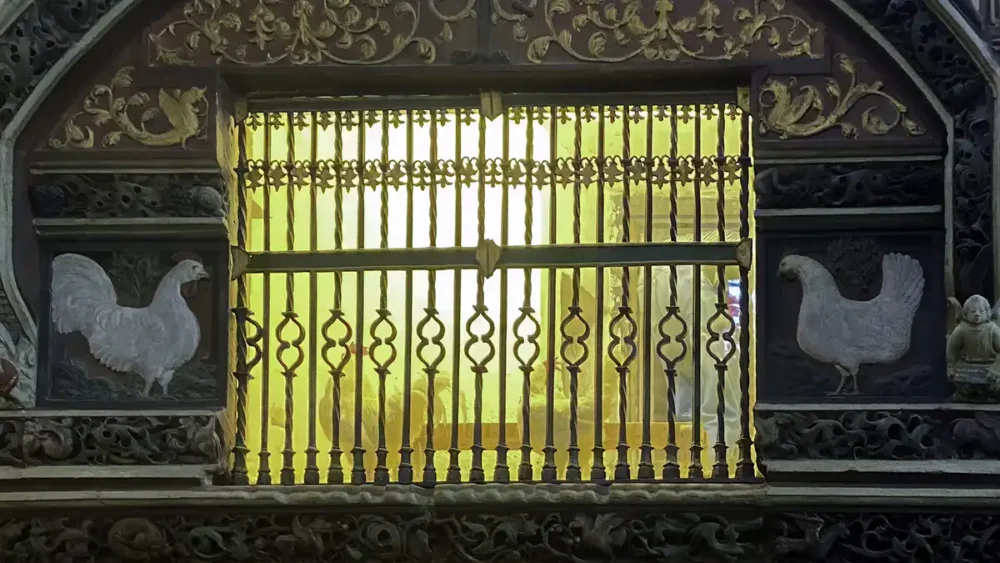
To this day, the cathedral maintains a live chicken and rooster inside a special enclosure, a unique tradition found nowhere else along the pilgrimage route.
A Welcome Stop for Modern Pilgrims
Santo Domingo de la Calzada is around 220 kilometres from Saint-Jean-Pied-de-Port, the traditional French starting point of the Camino Francés, making it a comfortable stopping point after about a week of walking for many pilgrims.
The town offers everything today’s walkers need:
- Pilgrim hostels (albergues)
- Hotels and guesthouses
- Cafés and restaurants
- Outdoor terraces
- Pharmacies and supermarkets
- Pilgrim services and stamps (sellos)
Its compact historic centre makes it easy to explore on foot before continuing west towards Belorado, Burgos and eventually Santiago de Compostela.
Rioja Country
One of the pleasures of reaching Santo Domingo de la Calzada is entering the celebrated wine-producing region of La Rioja.
Vineyards surround much of the countryside, and local restaurants often serve traditional Riojan dishes alongside the region’s world-famous wines.
Pilgrims frequently enjoy a well-earned glass of Rioja after a day’s walk, although many wisely wait until the day’s journey has ended.
Pilgrim Traditions
Like many Camino towns, Santo Domingo welcomes pilgrims with a mixture of history and hospitality.
Visitors often:
- Attend a pilgrim blessing at the cathedral.
- Collect a cathedral stamp for their credential.
- Visit the saint’s tomb.
- Photograph the famous chicken coop.
- Explore the medieval streets and plazas.
Many walkers comment that the town successfully balances its importance as a pilgrimage destination with the feel of a lived-in Spanish market town.
Why Santo Domingo de la Calzada Matters
The Camino de Santiago exists because generations of people maintained, improved and protected the route.
Few individuals contributed more than Saint Dominic.
Without his bridge, roads and hospital, this section of northern Spain would have remained one of the most difficult parts of the pilgrimage. His practical acts of kindness became the foundation for a thriving town that continues to welcome travellers nearly a thousand years later.
For modern pilgrims, Santo Domingo de la Calzada represents more than another overnight stop. It is a reminder that the Camino has always been built on generosity, hospitality and the willingness of ordinary people to help strangers on a remarkable journey.
Sources and Further Reading
Dominic de la Calzada – Wikipedia
Santo Domingo de la Calzada – City Council
Camino de Santiago – Wikipedia
Search