
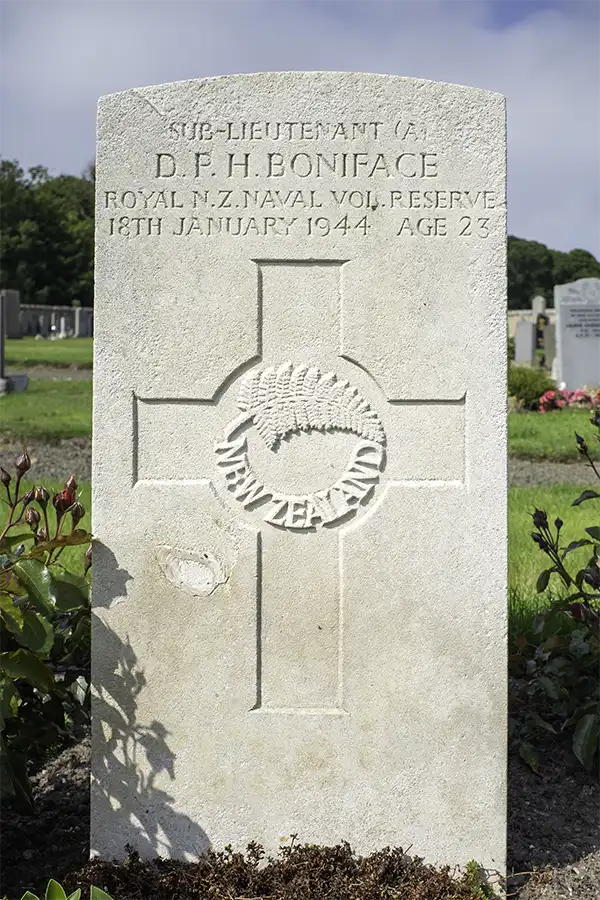
While photographing gravestones at Dirleton Cemetery in East Lothian, I came across the grave of a young New Zealand naval aviator who died during the Second World War.
Images © Steve Kydd
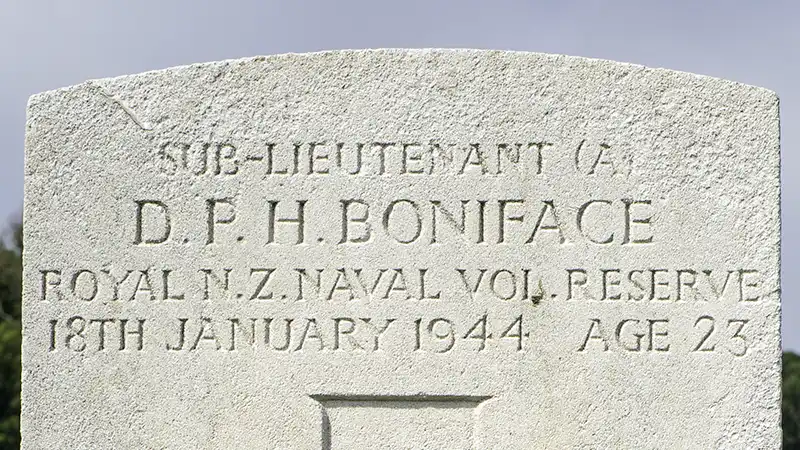
Gravestone Inscription
Sub-Lieutenant (A)
D. P. H. Boniface
Royal N.Z. Naval Vol Reserve
18th January 1944 Age 23
The inscription records Sub-Lieutenant D. P. H. Boniface, Royal New Zealand Naval Volunteer Reserve, who died on 18 January 1944, aged just 23.
His full name was Douglas Philip Hurlstone Boniface, and the story of how he came to be buried in a small East Lothian cemetery leads back to the wartime airfields at Drem and East Fortune.
Douglas Boniface
Douglas was born at Feilding, New Zealand, on 5 January 1921, the son of George Edward Boniface and Ethel Fanny Boniface.
He joined the Royal New Zealand Naval Volunteer Reserve (RNZNVR) during the Second World War and trained as a pilot in Canada. He received his pilot’s badge and was commissioned in February 1942.
Like many New Zealand airmen, his service eventually brought him to Britain and the Fleet Air Arm.
By December 1943, Boniface had been posted to 784 Naval Air Squadron, which was based at Royal Naval Air Station Drem in East Lothian.
The Royal Navy knew Drem as HMS Nighthawk, and used it extensively for night-fighter training.
A night flight from Drem
On 18 January 1944, Boniface took off from Drem in a Fairey Fulmar Mk I, serial number N1910.
The Fulmar was a two-seat Fleet Air Arm fighter used extensively during the earlier years of the war. By the time Boniface was flying at Drem, the aircraft were also being used for training.
According to accounts of the accident, this was Boniface’s first solo night-training flight.
Something went badly wrong.
Boniface appears to have mistaken the nearby airfield at East Fortune for Drem. At around 6.39 pm, his aircraft crashed into trees near Whitekirk, a few miles from both airfields.
The precise circumstances deserve a little caution, as much of the readily available information comes from later compilations of wartime aircraft losses rather than the original accident report. However, the aircraft, date, squadron and location of the crash are consistently recorded.
Buried at Dirleton
Douglas Boniface was buried at Dirleton Cemetery, not far from where he died.
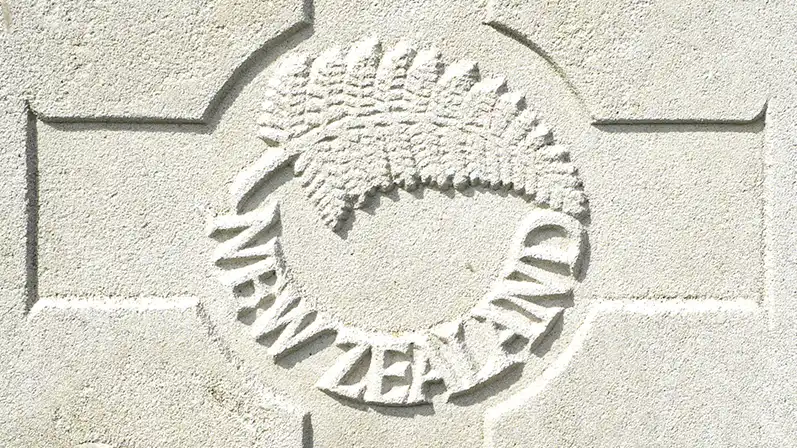
His grave records his service with the Royal New Zealand Naval Volunteer Reserve and his age of 23.
It is easy to pass a wartime grave and see little more than a name, rank and date. In this case, those few lines led to the story of a young New Zealander who had travelled thousands of miles from home and found himself learning to fly naval aircraft at night over East Lothian.
He died just thirteen days after his 23rd birthday.
Today the former wartime airfields at Drem and East Fortune remain familiar parts of the East Lothian landscape. East Fortune is now best known as home to the National Museum of Flight, while much of Drem’s wartime character remains recognisable.
Douglas Philip Hurlstone Boniface is someone whose story directly connects that landscape to the Second World War.
His grave at Dirleton is a small reminder of the many young men from New Zealand, Australia, Canada and elsewhere who came to Britain during the war and of those who never returned home.
Coastal Command Scottish Memorial – North Berwick
Search