
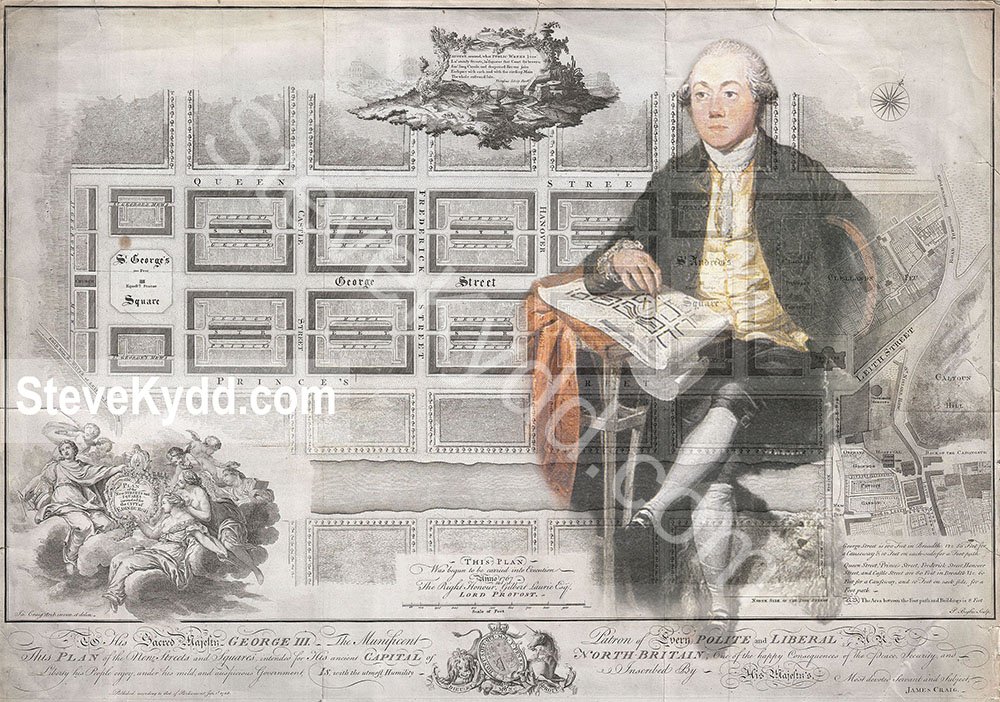
James Craig and his plan for Edinburgh’s New Town.
Few architects have influenced the appearance of Edinburgh as profoundly as James Craig, the young Scotsman whose plan for the city’s New Town helped transform Edinburgh from a crowded medieval burgh into one of Europe’s great Georgian cities.
Craig was born in Edinburgh on 31 October 1739. His father was William Craig, a merchant, and his mother was Mary Thomson, the sister of poet James Thomson, who wrote The Seasons and the words to Rule, Britannia!. Craig attended George Watson’s Hospital School. In 1755, he started working as an apprentice to Patrick Jamieson, a mason in Edinburgh. Unlike many other top architects of his time, Craig couldn’t afford the popular Grand Tour of Europe.
Edinburgh Looks North
By the middle of the 18th century, Edinburgh had a problem. Much of its population was concentrated within the cramped confines of what we now call the Old Town, where tall tenements crowded around the ridge running from Edinburgh Castle towards Holyrood.
City leaders wanted Edinburgh to expand. The open ground to the north of the Nor’ Loch offered the opportunity to create an entirely new district, with wider streets, substantial houses and the ordered urban environment expected of a modern European capital.
In 1766, Edinburgh Town Council held a competition for the layout of the proposed New Town. Six people submitted plans, and the judges selected James Craig, who was relatively unknown. He worked with others, including architect John Adam, to revise his design before the Town Council formally approved the final scheme in July 1767. The city awarded Craig a gold medal and the Freedom of the City for his achievement.
Craig’s Plan for the New Town
The brilliance of the final plan lay partly in its simplicity.
Three principal streets — Princes Street, George Street and Queen Street — ran broadly parallel from east to west. George Street occupied the central axis, with St Andrew Square at its eastern end and what became Charlotte Square at the west. Streets running north to south crossed these, creating the remarkably ordered grid that remains immediately recognisable today.
The street names showed support for the royal family and Scotland.
They named George Street after King George III, Princes Street after his sons, and Queen Street after his wife, Queen Charlotte. They added St Andrew Square to represent Scotland.
Craig’s published plan was dedicated to George III and described Edinburgh as the King’s “ancient capital of North-Britain”. Patrick Begbie published an engraving of the plan in 1768.
One important distinction is sometimes overlooked: James Craig did not design most of the buildings of Edinburgh’s New Town. His great contribution was principally as a planner. He established the streets, squares, plots and overall urban framework within which other architects and builders subsequently worked.
A City of the Enlightenment
Craig’s New Town appeared at an extraordinary moment in Edinburgh’s history. The city was at the heart of the Scottish Enlightenment, associated with figures including David Hume, Adam Smith, Joseph Black and other writers, scientists and philosophers.
The new streets provided an architectural expression of that changing Edinburgh. In contrast to the narrow closes and densely packed tenements of the Old Town, the New Town offered space, symmetry, light and order.
Development began at the eastern end around St Andrew Square and gradually moved westwards. The process took decades, and the New Town visible today was the work of many architects and several phases of expansion. Nevertheless, Craig supplied the fundamental idea from which much of what followed developed.
The result also produced one of Edinburgh’s most striking characteristics: the extraordinary contrast between the medieval Old Town and the planned Georgian New Town. That juxtaposition is now central to the character of the Old and New Towns of Edinburgh UNESCO World Heritage Site.
More Than a Street Plan
Craig continued to work as an architect and planner. One of his most important buildings was the Old Physicians’ Hall in George Street, constructed for the Royal College of Physicians of Edinburgh during the 1770s. The building no longer survives.
He also produced further schemes for improving Edinburgh. In 1786 he published Plan for Improving the City of Edinburgh, proposing an ambitious redevelopment associated with the approaches to the South Bridge. The scheme included more elaborate urban forms, including a crescent and an octagon, but much of it was never realised.
Craig also experimented with alternative versions of his New Town. Later plans introduced a large circus or circular space in the centre of George Street, but this proposal was never adopted.
James Craig’s Later Years
Despite the enormous importance of the New Town plan, Craig did not build quite the architectural career that such an extraordinary early success might have led others to expect.
His surviving body of architectural work is comparatively small, and his reputation rests overwhelmingly on his contribution to Edinburgh. He died unmarried in the West Bow on 23 June 1795.
By then the New Town was still being built. Charlotte Square was not completed until around 1800, after Craig’s death, and later generations of architects would extend Edinburgh far beyond the boundaries he had originally envisaged.
James Craig’s Legacy
More than 250 years later, it is difficult to walk through central Edinburgh without encountering James Craig’s legacy.
Princes Street, George Street, Queen Street, Hanover Street, Frederick Street, and the great squares remain part of the city’s everyday geography. Millions of residents and visitors move through a street plan conceived by a young Edinburgh architect in the 1760s.
Craig didn’t build the New Town all by himself, and he didn’t design the fancy building fronts that made it famous. Instead, his main accomplishment was creating the basic plan that allowed Edinburgh to grow into a new city.
His street plan gave the growing city a clear layout and lasting structure. Even though buildings, shops, and street uses have changed a lot over time, the main layout of Craig’s New Town is still there.
For an architect whose later career never quite matched the promise of his early success, it is an extraordinary monument. James Craig’s greatest surviving work is not a single building.
It is a large part of Edinburgh itself.
Search