
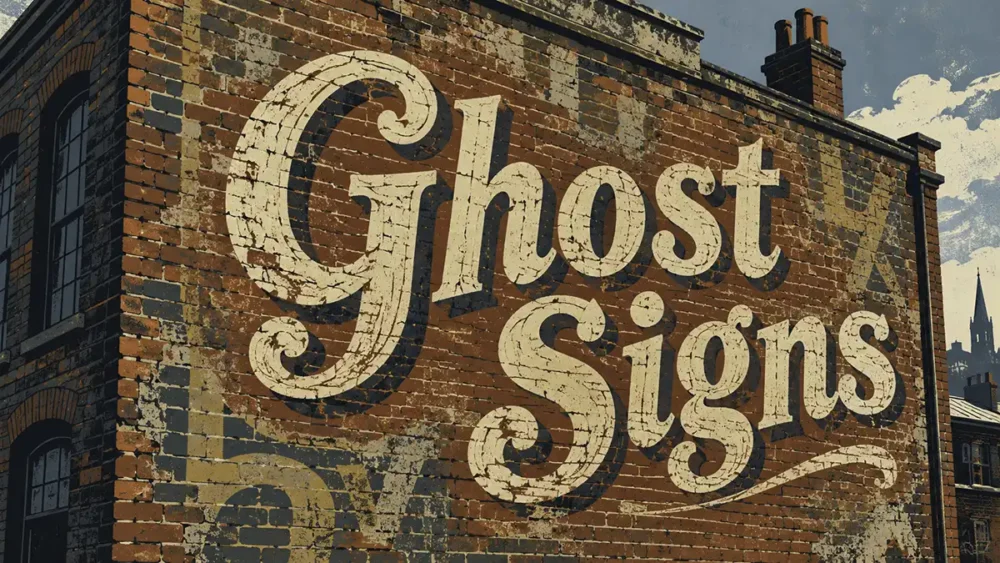
Ghost Signs: Look closely at Edinburgh’s walls, and you’ll occasionally see an earlier version of the city appear. You can still find faded lettering, fragments of advertisements, and the names of long-departed businesses on old buildings, shopfronts, and close entrances. These survivors are commonly known as ghost signs.
Once an everyday part of the streetscape, signs were painted directly onto brick, stone, render and timber to advertise shops, workshops, hotels, manufacturers and other businesses. Some were enormous advertisements intended to be seen from a distance; others directed customers through a close or passageway to a business hidden behind the main street.


Why do ghost signs survive?
One reason is the remarkably durable oil-based paint commercial signwriters traditionally used. Designed to withstand years of Scottish rain, frost and sunlight, these paints adhered particularly well to porous surfaces such as stone and brick. Although the colour gradually faded, traces of pigment could remain embedded in the surface for many decades.
Sometimes the lettering itself affected how the underlying masonry weathered, leaving a visible outline even after much of the original paint had disappeared.
Rather surprisingly, attempts to cover old signs have also helped preserve them. A later shop fascia, boarding, another coat of paint or even an adjoining building could shield earlier lettering from the weather. When these later additions are removed during renovation or redevelopment, a sign unseen for perhaps 50, 80 or 100 years can suddenly reappear.
Edinburgh’s accidental memorials
Edinburgh is particularly rich territory for ghost signs. Generations of shops, workshops, printers, warehouses and small manufacturers occupied the same streets and closes, particularly in the Old Town. Businesses disappeared, and buildings changed their use, but occasionally their names remained behind.
New examples keep emerging as buildings are renovated and old shopfronts removed. Others are gradually becoming less legible and may eventually disappear altogether.
That makes photographing them worthwhile. A ghost sign may have survived for a century yet vanish during a single refurbishment. A photograph creates a record of something which might otherwise be lost.
That is what makes ghost signs so fascinating. They were never intended to be historic monuments. They were simply advertisements and directions created for ordinary working businesses.
Through a mixture of durable paint, changing buildings and sheer chance, they have become accidental memorials to an Edinburgh that has disappeared.
This page records some of the ghost signs I have photographed around Edinburgh and, where possible, the stories of the businesses and people behind them.
Search