
Some people who helped shape the world
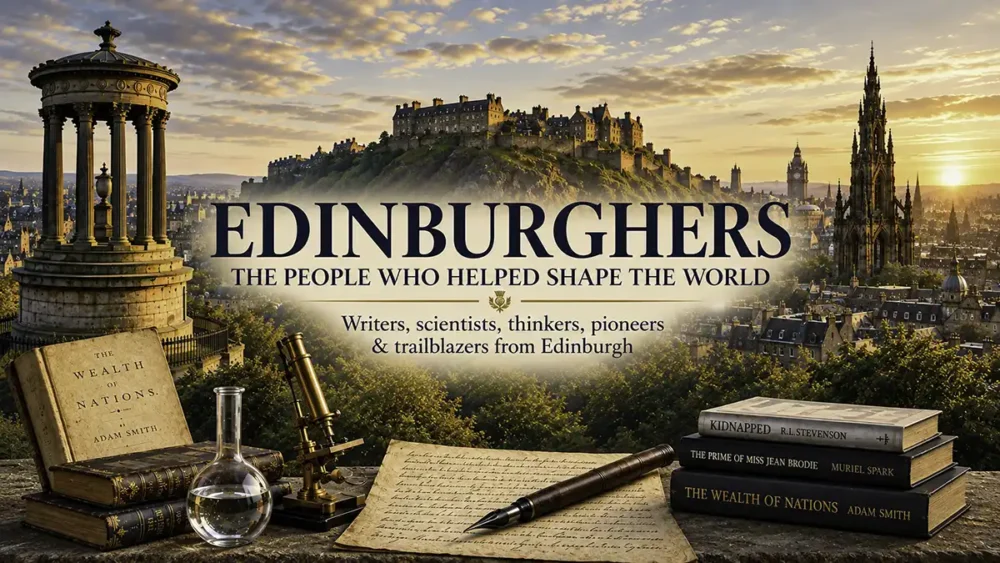
Edinburgh has produced, educated or attracted a remarkable number of people who went on to make their mark on the world.
Philosophers, scientists, doctors, writers, architects, campaigners and artists have all called the city home. Some were born here, while others came to Edinburgh to study or work and stayed long enough for the city to play an important part in their lives.
You could fill a book with them. This is simply a selection of Edinburghers whose ideas, discoveries and achievements travelled far beyond the city.
The Enlightenment City
Eighteenth-century Edinburgh became one of the great centres of the Scottish Enlightenment.
It was also a surprisingly small place for so much intellectual activity. Academics, doctors, scientists, writers and philosophers met in lecture rooms, clubs, taverns and each other’s homes. They discussed, argued over, and developed ideas.
Several of the best-known names of the period are still closely associated with Edinburgh.
David Hume (1711–1776)
Edinburgh-born David Hume became one of the most important philosophers of the eighteenth century.
His writing and thoughts on human nature, reason and scepticism influenced generations of thinkers and remain widely studied today.
Hume spent much of his life in Edinburgh and died at his home in the city’s New Town in 1776.
Adam Smith (1723–1790)
Edinburgh played an important part in the intellectual life of this son of Kirkcaldy.
His best-known work, The Wealth of Nations, published in 1776, became a founding text of modern economics.
Smith died in Edinburgh in 1790. He is buried in the Canongate Kirkyard.
Joseph Black (1728–1799)
Chemist and physician Joseph Black made important discoveries involving carbon dioxide, heat and temperature.
He became Professor of Medicine and Chemistry at the University of Edinburgh in 1766 and was another leading figure in the city’s Enlightenment circle.
His work helped lay some of the foundations of modern chemistry and physics.
James Hutton (1726–1797)
Edinburgh-born James Hutton changed the way scientists thought about the Earth.
Today he is often described as the Father of Modern Geology.
Edinburghers – Science, Discovery and Innovation
Edinburgh’s university, medical schools and hospitals have attracted scientists and doctors for centuries.
Some were born in the city. Others came here to study or work. Their discoveries would have consequences far beyond Scotland.
James Clerk Maxwell (1831–1879)
Born in Edinburgh, James Clerk Maxwell ranks among the great physicists.
His work on electromagnetism helped explain the relationship between electricity, magnetism and light.
He provided the foundation for technologies that would eventually include radio, television, telecommunications, and much of the electronic world we now take for granted.
Alexander Graham Bell (1847–1922)
Alexander Graham Bell was born in Edinburgh in 1847.
He grew up in a family with a strong interest in speech, elocution and communication, subjects that would influence his later work.
Bell is best remembered for his role in developing the telephone, although his interests were wide-ranging.
Charles Darwin (1809–1882)
Darwin arrived at the University of Edinburgh to study medicine in 1825.
Medicine wasn’t for him, but Edinburgh exposed the young Darwin to scientists, naturalists and new ideas. Those early experiences shaped the long road to his later work on evolution.
James Young Simpson (1811–1870)
James Young Simpson was one of Edinburgh’s best-known Victorian doctors.
In 1847, Simpson and his colleagues experimented with chloroform and recognised its potential as an anaesthetic.
Its adoption changed surgery and childbirth and made Simpson internationally famous.
His Edinburgh home at 52 Queen Street became a meeting place for doctors, scientists and other prominent figures of the day.
Literary Edinburgh
Edinburgh has a particularly strong claim to literary fame.
The city has produced some of the world’s best-known writers and fictional characters, while Edinburgh itself has often found its way into their work.
Sir Walter Scott (1771–1832)
Few writers have influenced how the world sees Scotland as much as Sir Walter Scott.
Through novels including Rob Roy, Ivanhoe and the Waverley series, Scott turned Scottish history, legend and landscape into hugely popular literature.
His readers included Queen Victoria.
Scott’s reputation has risen and fallen over the years, but his influence is hard to escape. Edinburgh’s enormous Scott Monument clearly reminds us how highly he was once regarded.
Robert Louis Stevenson (1850–1894)
Robert Louis Stevenson was born at 8 Howard Place in Edinburgh in 1850 and grew up mainly at 17 Heriot Row.
Edinburgh remained an important influence on him even after he left Scotland.
The contrasts of the city, respectable New Town streets on one side and the darker closes and wynds of the Old Town on the other, provided plenty of material for a writer fascinated by the different sides of human nature.
Treasure Island and The Strange Case of Dr Jekyll and Mr Hyde remain among the best-known books in English literature.
Robert Louis Stevenson’s Memorial – St Giles Cathedral
Arthur Conan Doyle (1859–1930)
Creator of Sherlock Holmes, Conan Doyle was born in Edinburgh and studied medicine at the University of Edinburgh.
Muriel Spark (1918–2006)
Edinburgh-born Muriel Spark became one of Scotland’s most important twentieth-century writers.
Her best-known novel, The Prime of Miss Jean Brodie, is firmly rooted in Edinburgh.
Spark had a sharp eye for people and their weaknesses, and her Edinburgh is far removed from the usual romantic picture-postcard version of the city.
Naomi Mitchison (1897–1999)
Naomi Mitchison was a novelist, poet, essayist and political campaigner whose long life covered almost the entire twentieth century.
Born in Edinburgh, she wrote on everything from history and science fiction to politics and women’s rights.
She was an unusually varied writer and thinker who never seemed particularly interested in staying within one category.
Edinburghers – Women Who Changed Edinburgh
Edinburgh’s history isn’t just a roll call of famous men.
Women played an important part in changing the city’s schools, universities, hospitals and public life, often while facing barriers that their male contemporaries never had to consider.
Elsie Inglis (1864–1917)
Doctor and suffragist Elsie Inglis became one of Edinburgh’s great medical reformers.
During the First World War, she helped establish the Scottish Women’s Hospitals, which sent medical teams overseas to treat wounded soldiers.
Inglis also campaigned for better medical care for women and for women’s right to vote.
Her name remains familiar in Edinburgh, not least because of the former Elsie Inglis Memorial Maternity Hospital.
Sophia Jex-Blake (1840–1912)
Sophia Jex-Blake was one of the driving forces behind the Edinburgh Seven, the group of women who fought for the right to study medicine at the University of Edinburgh.
They met considerable hostility.
They didn’t win immediately, but their campaign helped force open the doors of British medical education to women.
Chrystal Macmillan (1872–1937)
Edinburgh-born Chrystal Macmillan was a lawyer, suffragist and peace campaigner.
She became the first woman to argue a case before the House of Lords when she challenged the exclusion of women university graduates from voting.
Macmillan later became involved in international campaigns for women’s rights and peace.
Flora Stevenson (1839–1905)
Flora Stevenson spent much of her life improving education in Edinburgh.
She was particularly concerned with the education of poorer children and girls, who were overlooked.
Stevenson served on the Edinburgh School Board for more than 30 years and became one of the city’s most respected educational reformers.
Her name lives on at Flora Stevenson Primary School in Comely Bank.
Edinburghers – Architects, Artists and Cultural Figures
Edinburgh’s contribution isn’t confined to books, science and medicine.
The city has also produced architects, artists and performers whose work became known worldwide.
Robert Adam (1728–1792)
Born in Kirkcaldy into a family of architects, his elegant neoclassical style of architecture became fashionable across Britain and strongly influenced the development of Georgian Edinburgh.
Adam and his contemporaries helped create the architectural character we now associate with Edinburgh’s New Town.
Eduardo Paolozzi (1924–2005)
Eduardo Paolozzi was born in Leith to Italian parents. He pioneered British Pop Art and developed an international reputation as a sculptor and artist.
Edinburgh has several examples of his work, and the National Galleries of Scotland holds a substantial collection.
Sean Connery (1930–2020)
Sean Connery was born in Fountainbridge in 1930.
Before acting took over his life, he had a remarkably varied career, including working as a milkman in Edinburgh.
He eventually became one of the world’s most recognisable film stars.
For many, Sean Connery remains the definitive James Bond.
A City of Ideas
Philosophers and physicists, novelists and doctors, campaigners and actors. Some spent their whole lives in Edinburgh; others were here for only part of theirs.
And this is far from a complete list.
Edinburgh had the advantage of bringing people together. The university, medical school, hospitals, libraries, publishers, clubs and learned societies all played their part. So too did the less formal meeting places: taverns, coffee houses, and drawing rooms where people talked, argued, and exchanged ideas.
Walk around Edinburgh today, and many of these Edinburghers are still there. They appear on statues, plaques, buildings, street names and gravestones.
Search